FEF FILES AN AMICUS BRIEF IN THE VIRGINIA TIKI-TORCH CASE
On June 9, 2026, The Free Expression Foundation filed an Amicus Curiae brief in the Virginia Court of Appeals in the Invictus v. Commonwealth appeal, arguing that in light of settled First Amendment precedent Augustus Sol Invictus’s conviction under Virginia Code § 18.2-423.01 should be set aside. Commenting on this case, FEF’s President Glen Allen stated that: “Mr. Invictus’s conviction under this politically-motivated prosecution is an affront to our First Amendment traditions on multiple levels. He should never have been prosecuted. Having been prosecuted, he should never have been convicted. FEF supports the decisive nullification of Mr. Invictus’s conviction and his prompt return to freedom.”
The basic facts of Mr. Invictus’s conviction are these. On April 3, 2023 – nearly six years after the date of Mr. Invictus’s alleged offense – a newly elected prosecutor sought and obtained a grand jury indictment charging Invictus with violating Virginia Code § 18.2-423.01, Virginia’s “burning object” statute, which makes it a felony offense to publicly burn an object “in a manner having a direct tendency to place another person in reasonable fear or apprehension of death or bodily injury” and “with the intent of intimidating any person or group of persons.” This section is found in the same part of the Virginia Code as § 18.2-423, which makes it a felony to burn a cross on the property of another, a highway, or a public place with intent to intimidate any person or group. Section 18.2-423 was famously challenged in the landmark Supreme Court case of Virginia v. Black, which affirmed that while cross-burning can be banned when intended to intimidate, the statute’s provision treating the burning itself as proof of intent is unconstitutional.
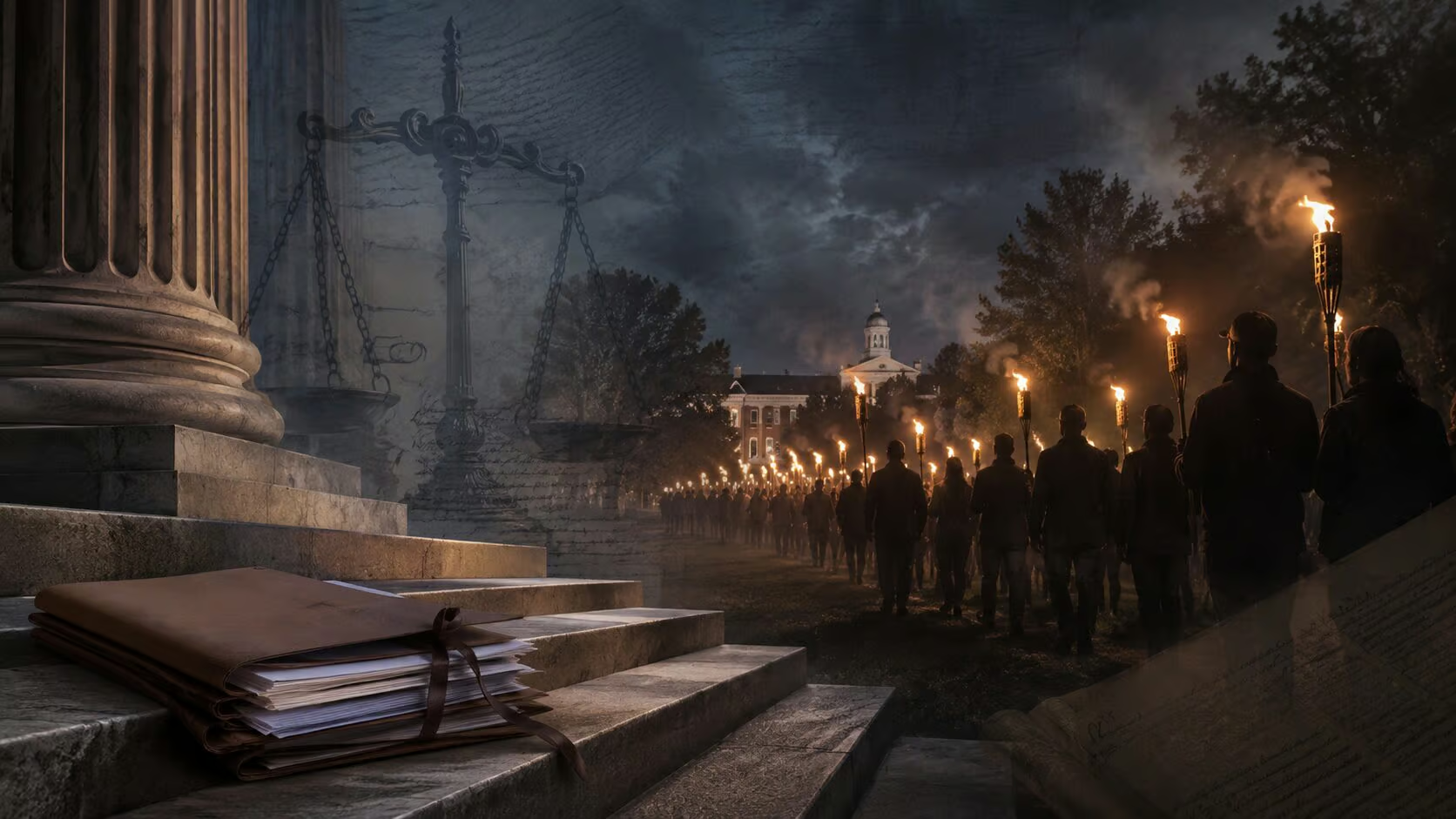
Mr. Invictus was a participant in a march through the University of Virginia campus on the night of August 11, 2017 as part of the wider Unite the Right protest against the planned removal of a statue of Confederate General Robert E. Lee located in a Charlottesville park which at the time bore Lee’s name. The August 11 march was widely publicized after it occurred, in large part due to the marchers’ use of tiki torches. Mr. Invictus carried one such tiki torch and filmed himself as he peacefully demonstrated alongside his fellow marchers.
Calls to prosecute the tiki torch marchers began almost immediately following the conclusion of the march. In September 2019, Anne Coughlin, a law professor at the University of Virginia, argued in a local publication that the marchers should be prosecuted under § 18.2-423.01. In the same article, Robert Tracci, the then-Albemarle County commonwealth’s attorney who had jurisdiction over the case, explained that § 18.2-423.01 was likely inapplicable to the carrying of tiki torches in the same manner as the August 11 marchers. And because, as Mr. Tracci put it, “a prosecutor must faithfully apply the law and uphold ethical standards in all cases,” the commonwealth attorney’s office declined at the time to prosecute the torch marchers unless there was evidence they committed a crime such as “malicious bodily injury, illegal use of tear gas, [or] assault and battery.”
But in 2020 the current Albemarle County commonwealth’s attorney, Mr. James Hingeley, was elected. Mr. Hingeley claims he was inspired to run for office because of Mr. Tracci’s refusal to prosecute the marchers for the carrying of tiki torches, and as part of his campaign Mr. Hingeley promised to “prosecute these people.” On April 3, 2023—approximately sixty-eight months after the Unite the Right protests—Mr. Invictus was indicted on one count of violating § 18.2-423.01. Mr. Invictus was convicted on this count on October 11, 2024. On January 8, 2025, he was sentenced to five years in prison, with all but nine and a half months to be served by a period of probation.
FEF strongly believes Mr. Invictus’s conviction cannot be squared with First Amendment doctrine. Indeed, Virginia’s “burning object” statute has come up for review by the United States Supreme Court at a time when the statute encompassed only cross burnings. In Virginia v. Black (2003) the Court held that “the First Amendment permits Virginia to outlaw cross burnings done with the intent to intimidate because burning a cross is a particularly virulent form of intimidation.” In reaching this holding, the Court discussed the history of cross burnings in America and concluded that “often the cross burner intends that the recipients of the message fear for their lives” and that “when a cross burning is used to intimidate, few if any messages are more powerful.” This conclusion followed from the Court’s longstanding “true threats” doctrine, which allows punishment for “statements where the speaker means to communicate a serious expression of an intent to commit an act of unlawful violence to a particular individual or group of individuals.”
The Court, however, struck down the Virginia statute’s requirement that “[a]ny such burning of a cross shall be prima facie evidence of an intent to intimidate a person or group of persons.” This was because, while history demonstrated that cross burning could be done with the intent to threaten, this was not the only reason someone would burn a cross; rather, cross burning could also be used as “a statement of ideology, a symbol of group solidarity,” or for artistic purposes. It is FEF’s position that because these latter examples of cross burning carried out without intention to intimidate amount to a form of expression that could, in the words of the Court in Connick v. Myers (1983), “be fairly considered as relating to any matter of political, social, or other concern to the community,” such cross burning would occupy the “highest rung of the hierarchy of First Amendment values” and would be “entitled to special protection.” The Black Court seemed to agree, noting that “[b]urning a cross at a political rally would almost certainly be protected expression.” And so, it is also FEF’s position that peacefully carrying a properly lit tiki torch at a political rally must also be First Amendment protected expression.
As FEF explains in its amicus brief, at trial Virginia seemed to concede the legality of merely carrying a lit tiki torch at the August 11 march. Nor was it alleged that Mr. Invictus committed an assault, a battery, or some other alleged crime apart from the offense related to the “burning object.” Indeed, in his closing argument to the jury, the assistant commonwealth’s attorney stated it was “not illegal to walk through the grounds in a procession with lit torches and chanting.” Rather, the Commonwealth’s theory of the case was that Mr. Invictus violated Virginia Code § 18.2-423.01 when, along with the other marchers, he allegedly surrounded and outnumbered counter-protestors who had arrived earlier at the march’s end point to disrupt the planned speaker.
FEF does not believe this theory can be sustained, and its amicus brief argues forcefully that under current precedent it cannot be illegal for one group of protestors to simply outnumber a competing group, that a group of demonstrators cannot circumscribe the scope of competing demonstrators’ speech and expressive conduct in a public square by preemptively positioning themselves at the center of the public square, and that an individual’s mere presence at the site of First Amendment protected assembly is insufficient to support a conviction based upon a concerted action theory where sporadic acts of violence were alleged to occur by persons other than that individual.
In arguing that Mr. Invictus’s conviction should be set aside, FEF’s brief recounts the facts described in the “Independent Review of the 2017 Protest Events in Charlottesville, Virginia,” also known as the “Heaphy Report.” The Heaphy Report establishes that while the tiki torch march’s organizers sought to avoid contact with counter-protestors and took actions to that effect, nonetheless Antifa and its affiliates deliberately sought to disrupt the march. FEF also draws attention to video Mr. Invictus personally captured on the night of August 11 which shows the entirety of the march from his perspective and conclusively shows Mr. Invictus did not counsel or encourage violence, nor did he ever engage in violence himself or abet violence.
A successful appeal would not make Mr. Invictus whole for the ordeal the Commonwealth of Virginia has put him through, but it would vindicate his First Amendment rights and the First Amendment rights of similarly situated individuals going forward. The Free Expression Foundation thanks Mr. Invictus’s attorney Terrell Roberts III for his stalwart representation of Mr. Invictus, and Virginia attorney Andy Bisulca for sponsoring FEF’s pro hac vice filing of its brief.
FEF’s amicus brief in this case is the latest in its efforts to assist those unjustly prosecuted and subjected to lawfare in the wake of the Unite the Right rally. FEF previously filed an amicus brief before the United States Supreme Court in another UTR related case, Balogh v. City of Charlottesville, and in United States v. Miselis, a UTR related case in the United States Fourth Circuit Court of Appeals. Our continued advocacy for the free expression rights of political dissidents is only possible with your continued assistance. Tax deductible donations may be made here. Thank you.
Read the amicus brief before the Virginia Court of Appeals here