Rob Rundo’s Unenforceable Rights
How the Government Imprisoned Him Without Charges
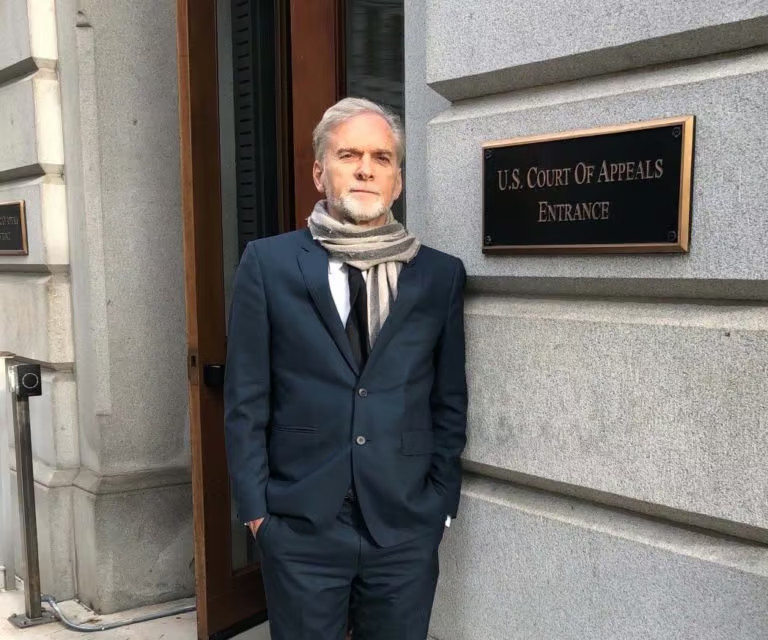
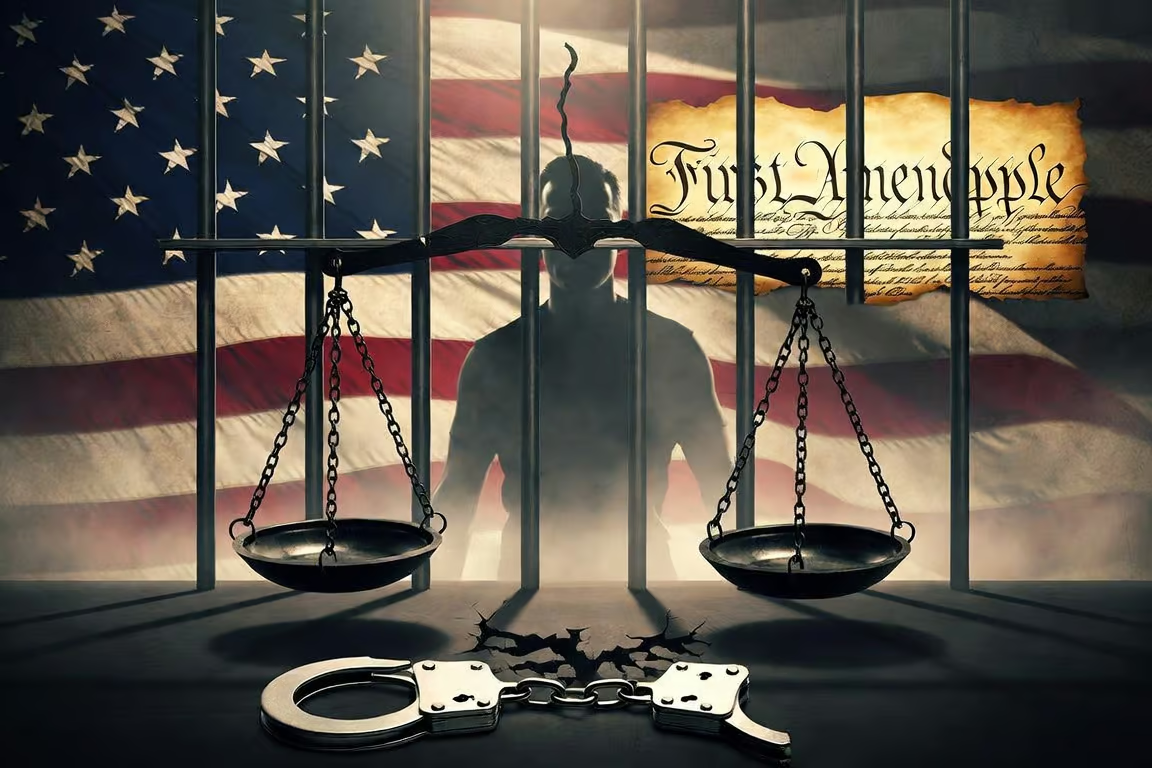
The Constitution guarantees every citizen certain rights. But an official told Rob Rundo, founder of the Active Club movement, something else: “You have the rights you can enforce.” Mr. Rundo experienced the reality of this seldom spoken maxim at the hands of the American justice system when he was incarcerated without charge for 147 days.
When Mr. Rundo was first arrested in 2018 in connection with the Rise Above Movement’s involvement in various political flashpoints of 2017, the government alleged violations of the federal Anti-Riot Act. Judge Cormac Carney of the Central District of California dismissed these charges in 2019, holding that the Anti-Riot Act was overbroad and unduly burdened First Amendment expression. Mr. Rundo, now a free man with no pending charges, left the country. The government promptly filed an appeal of Judge Carney’s decision and the Ninth Circuit Court of Appeals reversed. Following lengthy extradition proceedings, the long arm of the law brought Mr. Rundo back to the United States in 2023 to face the same charges as before.
Judge Carney again dismissed the charges, this time on grounds of selective prosecution. As Mr. Rundo’s attorneys argued, the Department of Justice left unmolested countless violent Antifa activists at the same events. Judge Carney released Mr. Rundo on February 21, 2024. The government then filed an emergency appeal for a stay of the release order and against Judge Carney’s second ruling. The Ninth Circuit granted the stay for the duration of the appellate proceedings even though Mr. Rundo had already been released. The government contended that Mr. Rundo was a flight risk, citing his legal departure from the country after his first release five years prior.
Simultaneously, the government returned to the District Court, which had already lost jurisdiction, to seek an arrest warrant. Magistrate Judge Steve Kim granted the request on the government’s false assurances that their conduct was in accordance with due process. Erin Murphy, Mr. Rundo’s attorney, quipped at the February 23 status conference, “I think that if I engaged in even a fraction of that kind of gamesmanship, I don’t know that I’d have my license anymore.” United States v. Rundo, No. CR 18-00759-CJC, Status Conference Tr. at 14:3–5 (C.D. Cal. Feb. 23, 2024). Judge Kim called the government’s conduct “misrepresentation” and “an abuse of power” and would not have issued the warrant if fully informed. Id. at 14:12-14; 42:12. Judge Kim further admonished the government: “You [the government] seem to be determined that, when the process is unclear, it doesn’t matter, whatever the shortest path is that I can get there. And you represent all of these things as if that is simple.” United States v. Rundo, No. 2:18-cr-00759-CJC, ECF No. 366 at 39:25, 40:1–4 (C.D. Cal. Feb. 23, 2024).
Less than 24 hours after his release, Mr. Rundo was back behind bars on a faulty warrant. In layman’s terms, Rundo had no charges pending against him but remained incarcerated. Judge Carney expounded on the government’s underhanded conduct, “If Mr. Rundo was a popular figure in today’s society . . . there would be complete outrage about what’s happened here.” Rundo, ECF No. 373 at 27:3-6. The United States Attorney at the conference offered this response after a lengthy exchange: “The Government’s position has been we do not believe that the defendant is entitled to any sort of appearance in front of a judge in light of the Ninth Circuit’s decision,” contradicting the government’s promise to Judge Kim that Rundo would receive due process upon re-arrest. Id. at 34:24-25, 35:1. Judge Carney asked, if the government’s position were true, why was the arrest warrant even sought from Judge Kim? The U.S. Attorney could only offer that this action was undertaken out of an “abundance of caution.” Id. at 35:18.
Mr. Rundo’s unconventional imprisonment would last until the appellate court adjudicated the government’s appeal in July 2024. As Judge Carney lamented, “It bothers me. It doesn’t matter whether Mr. Rundo is a good man, a bad man, whether he did something wrong here or not. We’re all entitled to our Constitution, and no one’s following the rules, and I’m at a loss to understand it.” Rundo, ECF No. 373 at 10:15–19. He continued, “throwing out fundamental criminal rules of procedure and going out to arrest someone without pending charges, that’s frightening to me.” Id. at 10:24-25, 11:1.
The Ninth Circuit ultimately reversed Judge Carney’s second dismissal, and the prosecution of Rundo continued. The issue of his arrest on an improper warrant was never fully adjudicated due to the pending appellate proceedings. After six years of legal battles, he pled guilty to one count of conspiracy to violate the Anti-Riot Act. The court sentenced Rundo to 24 months in federal prison and two years of supervised release, though he already served his prison term across the multi-year struggle. He is now, at last, free, albeit on probation (which will end in December of this year).
In sum, Mr. Rundo spent 725 days in custody in four different countries, 147 of which were spent with no pending charges at all. The Constitution said he had rights. The government disagreed. Just as the U.S. attorneys sought Mr. Rundo’s re-arrest out of an “abundance of caution,” activists must similarly be cautious of unaccountable judicial overreach. Further, dissidents must remember what the government official told Rundo: your rights exist only insofar as you can ensure their enforcement. The Free Expression Foundation stands ready to advocate for your First Amendment rights and demand enforcement of the law impartially.