How a Desire for Peace May Label Tucker Carlson a Foreign Agent
By Joseph McGraw
Introduction
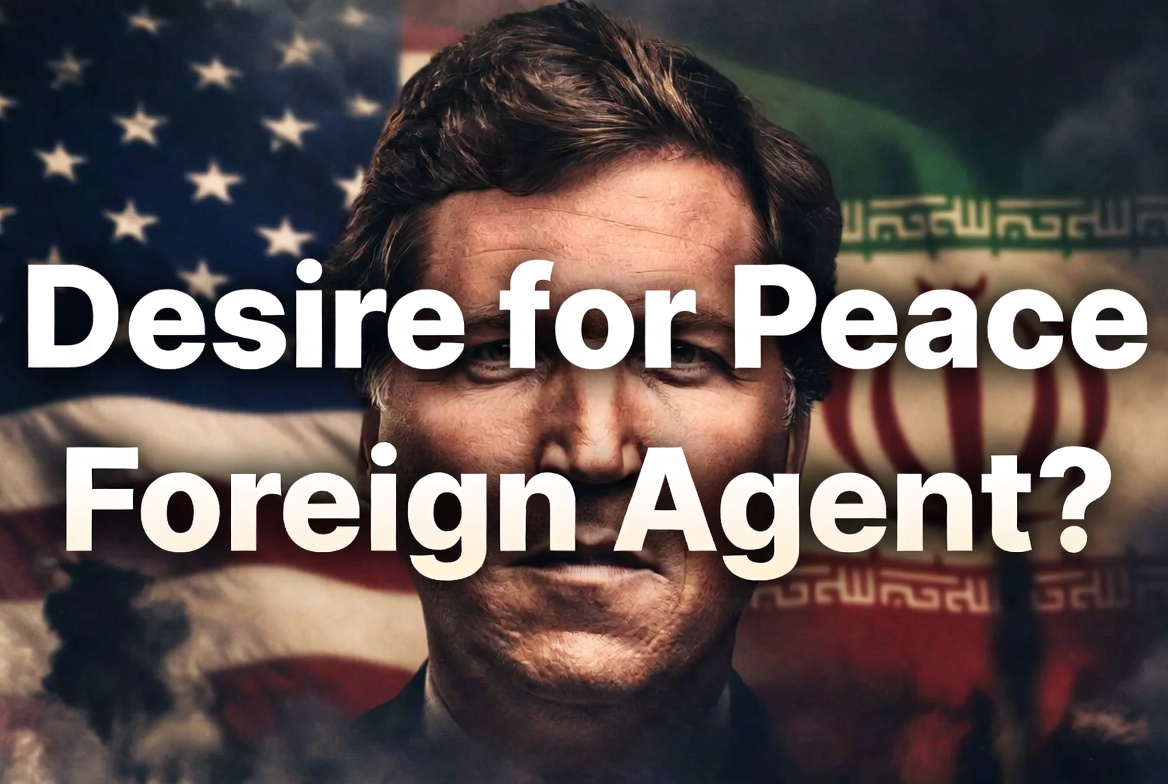
The dormant capabilities and vulnerabilities of the First Amendment face their greatest test in wartime. Recently, Tucker Carlson revealed that the Central Intelligence Agency intends to refer him to the Department of Justice to be charged for failing to register in accordance with the Foreign Agents Registration Act (FARA). In a number of his latest broadcasts, the pundit warned that free speech may soon become a casualty of the war with Iran. According to Carlson, the threatened criminal referral arises out of his contact with a number of Iranian nationals in the leadup to the present conflict. While the exact nature of his contact is unknown, the government may allege that he acted on the request of these foreign principals to advocate against the war. The action, in all likelihood, serves as a pretense for quashing his criticism and threatening other commentators to stay in line.
In close parallel, Laura Loomer, prominent Carlson detractor and close advisor to President Donald Trump, alleges that the pundit took money from a variety of Middle Eastern countries including Saudi Arabia and Qatar. In any case, Loomer has been pushing for his criminal investigation since at least February 1, a full month before the strikes. On March 14 she bragged, “If Tucker Qatarlson (sic) gets charged for violating FARA…I’m taking credit,” and “You have no idea how relentless I have been in speaking to GOP reps and even reporting Tucker to law enforcement and the DoJ.”
At long last, it appears her badgering of administration officials manifested into concrete action to silence speech amid the worsening war with Iran. While the criminal referral is a shot across Carlson’s bow regarding his anti-war speech, the government retains several pathways to materialize the threat. His legal footing hinges on three questions: 1) Is mere contact with citizens of another country with whom the United States is contemplating war enough to trigger mandatory registration under the FARA? 2) Did Carlson act on the request of a foreign principal to lobby for peace with Iran? or 3) If Loomer’s allegations are true, would taking money from foreign governments trigger mandatory registration?
The Statute
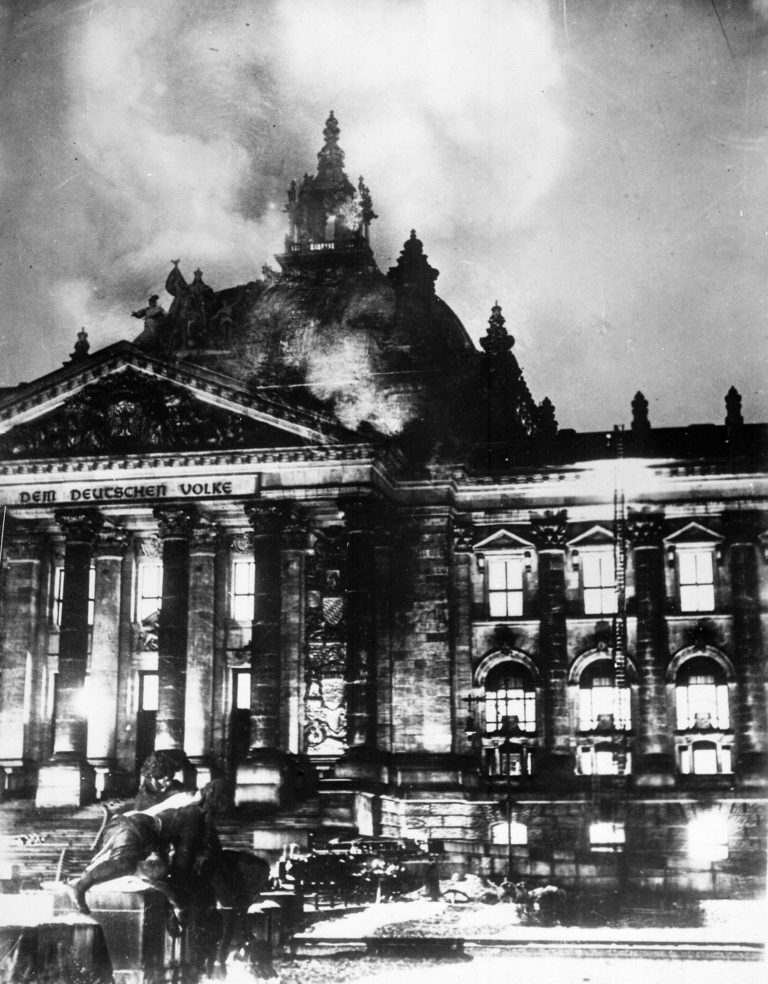
Signed into law in 1938, the FARA originated under the auspices of curtailing the influence of National Socialist Germany among American citizens. In its present form, the law requires that individuals falling into the category of “foreign agent” make a registration statement pursuant to 22 U.S.C. § 612 and disclose their activities. Foreign agents are defined in § 611(c)(1) of the statute as:
1) Any person who acts as an agent, employee, or under the control of a foreign principal and 2) advocates in some way in the interests of the foreign principal. Alternatively, one who holds himself out to be a foreign agent need not actually engage in advocacy to require registration. In both categories, an express contractual relationship between the individual and the foreign principal is not required to trigger the FARA. A foreign principal can include the government of another country, a “person outside the United States,” or an organization established under the laws of a foreign country. Notably, the FARA does not prohibit the advancement of foreign interests. In this way, the government argues free speech is not infringed though a chilling effect may result. Rather, the law requires that one disclose the agency behind the advocacy. To fulfill the advocacy requirement, one need only engage in political activity, act as a public relations agent, solicit donations, or represent the interests of the foreign principal to the U.S. government.
Does the FARA Violate the First Amendment?
While the Act does not explicitly limit speech, others have argued that the FARA chills First Amendment liberties by attaching negative labelling. In Meese v. Keene, the Supreme Court found this argument unconvincing for three reasons: First, Justice John Paul Stevens opined that the labels set up by congress in the FARA are meant to enhance truthful discourse by ensuring an informed public. Second, he contended that the labels in the Act have been law for so long that negative misinterpretation by the public should be a rare occurrence. Third, Stevens noted that the Court owes a level of respect to Congress in deciding to use terms like “political propaganda” as defined in the FARA. Consequently, the majority in Meese declined to find a chilling effect on free speech because the Act does not directly intervene in protected expression. Justice Harry Blackmun’s dissent, however, argued that the FARA’s labels are far from neutral. He elaborated, “The Court’s error on neutrality leads it to ignore the practical effects of the classification, which create an indirect burden on expression.” While the existing precedent holds that the FARA does not infringe on free speech, an enterprising advocate could petition the Supreme Court to overturn the holding in Meese.
Is Mere Contact with a Foreign Principal Enough?
Without more facts as to the relationship Carlson had with the Iranian nationals in question, one can only tentatively conclude he had some kind of communication with them. As defined in the Act, these individuals meet the definition of a foreign principal because they are persons outside the United States. The agency requirement of the FARA, however, is a much higher standard than mere contact. While an express contract is not required, the Third Circuit Court of Appeals noted in United States v. German-American Vocational League, Inc. that there must be mutual consent between the two parties as explained in the Restatement (1st) of Agency § 1. In other words, the agent must agree to act on behalf of and be subject to control by the foreign principal, and the foreign principal must agree that the agent so act. The FARA’s agency requirement, however, need not meet the Restatement (2d) of Agency’s more strict focus on control.
In Carlson’s case, the limited known facts do not lend themselves to his categorization as a foreign agent by contact alone. Surely the DoJ does not expect a journalist of national and international affairs to avoid speaking to citizens of another country for fear of triggering a FARA designation. Unless Carlson’s intercepted text messages contain some manifestation of consent to enter into an agency arrangement, the DoJ will have an extraordinarily uphill battle proving Carlson’s categorization under the Act. Even if these Iranian contacts were officials inside the Iranian government or members of the Iranian Revolutionary Guard Corps, the foreign principal’s proximity to state power does not lower the requirement that agency be established by mutual consent.
What If Iranian Nationals Requested that Carlson Lobby for Peace?
Some commentators like Loomer allege that Carlson, at the request of these Iranian nationals, lobbied the President to avoid war with Iran. The Second Circuit Court of Appeals in Irish Northern Aid Committee explained that FARA triggering requests must be analyzed according to the following factors: 1) If the request specifically named the would-be agent, 2) and the specificity of the action requested. Without more facts, Carlson’s agency under these allegations is unknown. Assuming the allegation’s truth, the DoJ may have a better case than using only Carlson’s contact with Iranian nationals. If one such Iranian individual, a foreign principal, requested that Carlson utilize his connections to gain audience with the President and lobby against the war, his actions may have been enough to establish agency under the Irish Northern Aid Committee standard. If the requester only asked Carlson to think about options to avoid war, agency may fail for lack of specificity. Without knowing the exact facts of the situation, it is difficult to predict where his actions fall on this spectrum.
Perhaps Carlson could argue that peace is in the interest of all nations, not just Iran. Nevertheless, the Act does not require that the interest in question be exclusive to the foreign principal. The statute explains that if one “represents the interests of such foreign principal before any agency or official of the Government of the United States,” he fulfills the advocacy requirement. If it can be shown that Carlson acted on a specific request to lobby the President by his Iranian contact, the DoJ may successfully argue that he represented the interests of Iran to the government. This is irrespective if that interest is shared by other countries or even the United States itself.
Does Taking Money from a Foreign Principal Make One a Foreign Agent?
Independent of the allegations of having contact with Iranian nationals, Loomer contends Carlson took money from various Middle Eastern governments. The simple act of receiving funds from a foreign government, however, is not enough to establish agency. In the 1966 amended text of the statute, the drafters noted, “mere receipt of a bona fide subsidy not subjecting the recipient to the direction or control of the donor does not require the recipient of the subsidy to register as an agent of the donor.” Illustratively, the court in Attorney General of the United States v. Irish People, Inc. agreed that even significant and repeated donations by a foreign principal do not decisively create agency unless there is an aspect of control. Loomer claims Carlson received funds to compensate him for his team’s travels. Unless this payment came with conditions that he report a certain way or shift his coverage on behalf of the interests of the subsidizing state, agency is not established.
The Defense of Selective Prosecution
Given the present American mediascape and scarce examples of enforcement of the FARA, Carlson could contend that the DoJ is selectively cracking down on those critical of the Iran War. The defense originates in the equal protection aspect of the Fifth Amendment’s due process clause. In Carlson’s case, he must show that the decision to prosecute arose out of “the desire to penalize the exercise of constitutional rights.” The constitutional right in this case would be his protected free speech. He must also show that the DoJ declined to prosecute similarly situated individuals on the other side of the issue.
But courts are likely to be hesitant to accept a selective prosecution defense because Carlson’s First Amendment rights may not actually be infringed. As the Irish People court elucidated, enforcement of the FARA does not criminalize the speech in question. The D.C. Court of Appeals explained that the government’s motive in that case was only “insuring that the people of the United States may appraise their statements in light of their source.” This is likely to be the same rebuttal the DoJ will take with regards to Carlson if he raises the defense of selective prosecution. They will argue that they do not seek to quash his protected speech, but only to apprise the American people of his concealed motivations.
Conclusion
If the DoJ finds that Carlson should have registered under the FARA, the most likely vector would be the Irish Northern Aid Commission request standard. They will attempt to establish that the pundit’s lobbying against the war was in response to a foreign principal’s request. The consequences of registration for an individual who makes his living on communication could be devastating. The DoJ could seek an injunction against any further broadcasting or video content until Carlson registers. If he complies with their demands, his content would likely need to carry disclaimers detailing his foreign alignment. The result would likely be a loss of credibility and reputation with his audience, a disastrous blow for an independent media figure. Moreover, using the FARA to chill constitutionally protected speech amid a new war would set a dangerous precedent for American political discourse. While the true facts of Carlson’s case are unknown, one may surmise that the government’s version of events paints a highly unfavorable view of his communications with foreign nationals. As the Iran conflagration spreads out of control, the appetite for harassing dissenters at home like Carlson is likely to grow in direct proportion.
Footnotes/Citations
- Loomer, Laura (@LauraLoomer). “Tucker Carlson needs to be investigated for possible FARA violations. Take a look at this video.” X (formerly Twitter), Feb. 1, 2026, https://x.com/LauraLoomer/status/2018054665099719041
- Loomer, Laura (@LauraLoomer). “If Tucker Qatarlson gets charged for violating FARA and or leaking information to Russia, …” X (formerly Twitter), March 14, 2026, 1:23 p.m., https://x.com/LauraLoomer/status/2032976193461633048
- U.S. Congress, Special Committee on Un-American Activities, Investigation of Nazi and Other Propaganda, 74th Cong., 1st sess., February 15, H.Rept. 153 (Washington: GPO, 1935), p. 2.
- 22 U.S.C. § 611(c)(2).
- Id.
- Id. § 611(b).
- 22 U.S.C. § 611(c)(1).
- Meese v. Keene, 481 U.S. 465, 479 (1987).
- Id. at 480.
- Id. at 483.
- Id. at 484.
- Id. at 486.
- Id. at 490.
- United States v. German‑Am. Vocational League, Inc., 153 F.2d 860, 864 (3d Cir. 1946).
- Attorney Gen. of the U.S. v. Irish N. Aid Comm., 668 F.2d 159, 161 (2d Cir. 1982).
- Id.
- 22 U.S.C. § 611(c)(1).
- H.R. Rep. No. 1470, 89th Cong. 2d Sess. 5-6 (1966)
- Attorney Gen. of the U.S. v. Irish People, Inc. 796 F.2d 520, 524 (D.C. Cir. 1986).
- United States v. Swanson, 509 F.2d 1205, 1208 (8th Cir. 1975); United States v. Berrios, 501 F.2d 1207 (2d Cir. 1974).
- Irish People, Inc. 796 F.2d 520, 525.
- Id. at 526.