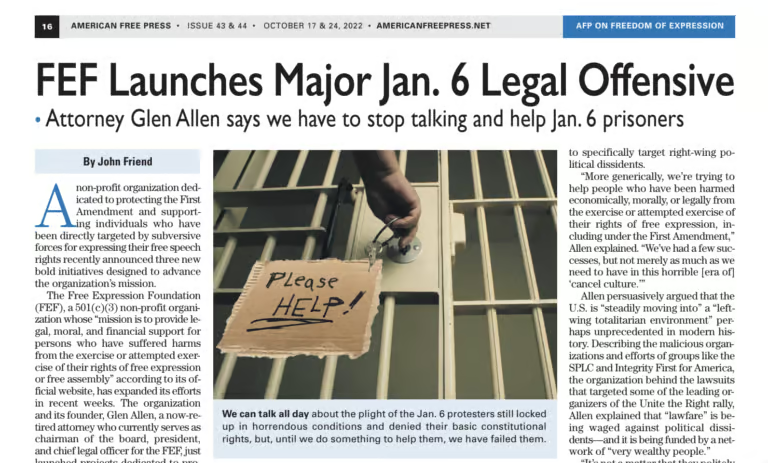
Update on Three Major FEF Cases
By FEF Staff
1) Jacobs, et al. v. Caitlin, et al. (Federal Court, Northern District of Georgia)
Matthew and Hillary Jacobs were arrested and Michael Weaver was threatened with arrest in Georgia for alleged “littering” based on their distribution of flyers critical of Jewish power and influence. Mr. Jacobs was assaulted by a jail guard while he was incarcerated after his arrest. Mr. Weaver, reasonably believing he would receive similar mistreatment, went into reclusion.
In March 2025, the Jacobs and Mr. Weaver, represented by Glen Allen, Randy Sheppard, and Fred Kelly (the “FEF Lawyers”), filed in Georgia federal court a complaint against (among others) several deputies and employees of the Douglas County, Georgia Sheriff’s Office alleging numerous claims, including First Amendment retaliation. The District Court dismissed the complaint based on federal abstention doctrine, under which a federal court may abstain from adjudicating a case if doing so would interfere with a pending state court prosecution. This doctrine is subject to important exceptions, including bad faith state prosecution. The FEF lawyers argued these exceptions applied in this case, but the District Court rejected these arguments.
In October 2025, the FEF lawyers appealed the case to the Eleventh Circuit Court of Appeals. That appeal has now been fully briefed and awaits oral argument or further action by the federal appellate court.
Meanwhile, the Georgia state prosecutors, after long delays, finally took initial steps to prosecute the Jacobs in state court on the bogus “littering” charges. In late April 2026, Randy Sheppard on behalf of the Jacobs filed and argued a motion to dismiss the littering charges against the Jacobs on the grounds that the political flyers in question were not “litter” as defined under the relevant Georgia statute. The Georgia state trial court has taken the motion under advisement and promised it will soon issue a decision.
The Jacobs, Mr. Weaver, and the FEF Lawyers now await that state court decision and also await further developments in the federal appeal.
2) Sines, et al, v. Nathan Damigo (Federal Court, Eastern District of California)
Nathan Damigo was among numerous defendants subjected to a jury verdict that awarded over $3 million to the plaintiffs in the Sines, et al. v. Kessler, et al. case (the Unite the Right case in the federal court for the Western District of Virginia in Charlottesville). This huge damages award was legally dubious as to all defendants but especially as to Mr. Damigo, who had been found liable by the jury on only one count (there were six counts in the complaint), i.e., civil conspiracy, and on that count the jury awarded merely $1.00 in nominal damages. The trial court in the Virginia case, however, held that all defendants were jointly and severally liable, i.e., each liable for the entire amounts that had been awarded on four separate counts, including those on which Mr. Damigo was not a named defendant. Mr. Damigo thus became liable for the large amounts awarded against other defendants, for example, James Fields, even though Mr. Damigo had no connection to Mr. Fields.
Mr. Damigo filed for bankruptcy in 2019, as he was entitled to do, seeking to discharge the Sines v. Kessler jury award against him. The Sines v. Kessler plaintiffs later filed a complaint in the bankruptcy court to prevent him from discharging that debt. They thus carried out the vindictive threat made by Roberta Kaplan, lead attorney for the plaintiffs in the Sines v. Kessler case, who had publicly vowed that “We absolutely can and will bankrupt these groups. And then we will chase these people around for the rest of their lives. So if they try to buy a new home, we will put a lien on the home. If they get a new job, we will garnish their wages.” *1
Glen Allen entered the case for Mr. Damigo at the bankruptcy court, seeking to defend and protect Mr. Damigo’s right to discharge the Sines v. Kessler jury award. After extensive summary judgment briefing and a hearing, the bankruptcy court ruled for the Sines v. Kessler plaintiffs, holding that Mr. Damigo had supposedly inflicted a “willful and malicious injury” that was not dischargeable. Mr. Allen has now filed an appeal to the District Court (federal) on Mr. Damigo’s behalf, submitting on April 24, 2026 a lengthy brief (34 page) and appendix (447 pages) in support of the appeal. The attorneys (there are many) for the Sines v. Kessler plaintiffs will file their opposition brief on or before May 25, 2026.
Any persons interested in reading the brief filed on Mr. Damigo’s behalf may access it on the FEF website here.
3) Kuriakose v. Metropolitan African Methodist Episcopal Church (District of Columbia Court of Appeals)
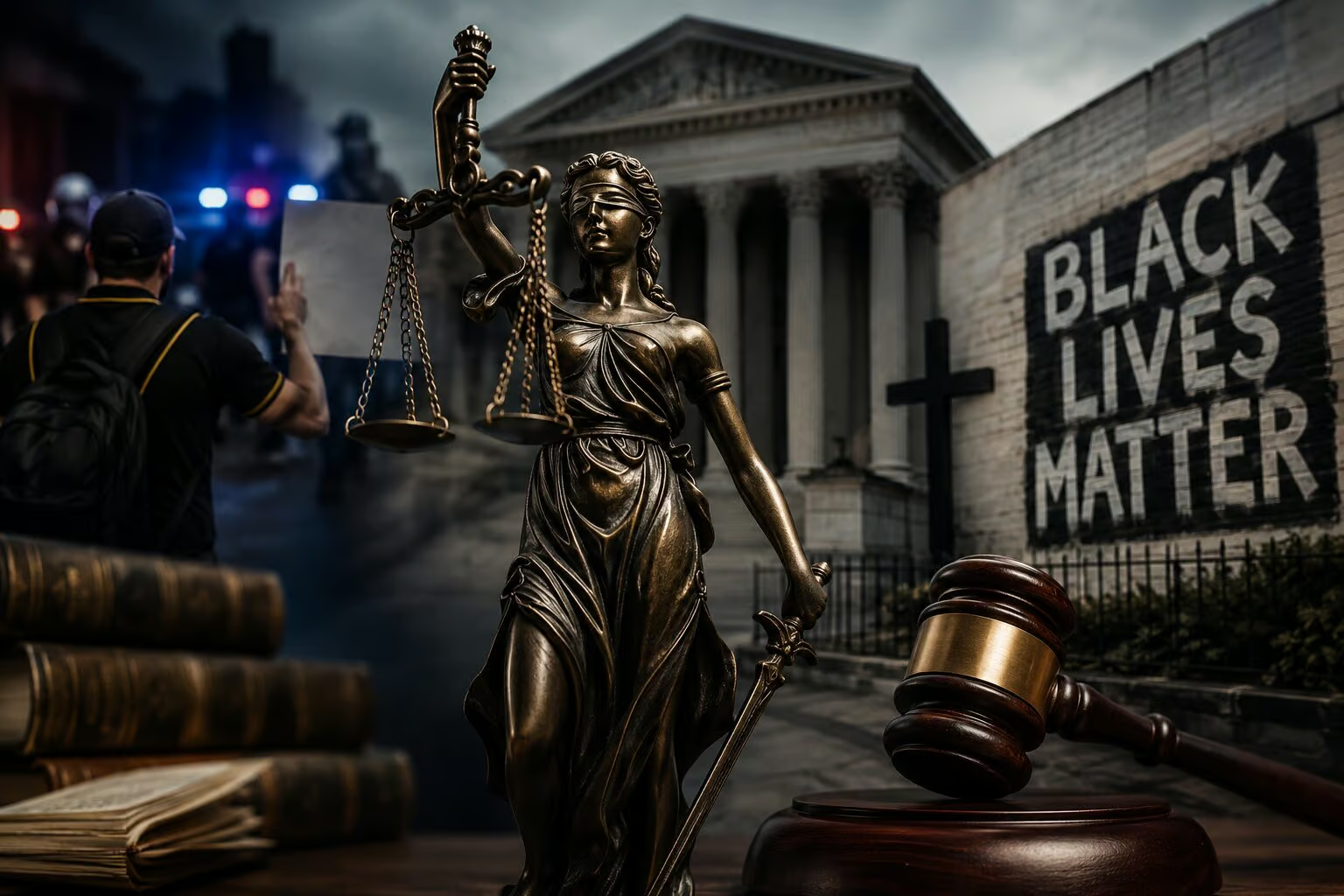
During the tumultuous Pro-Trump “Stop the Steal” rally held in the District of Columbia in December 2020, several members of the Proud Boys organization jumped over a fence surrounding a Metropolitan African Methodist Episcopal Church and tore up a Black Lives Matter sign on the church’s property. David Kuriakose was not among them but happened to be nearby when the incident occurred. The Paul Weiss law firm that represented the church in a subsequent civil rights action nonetheless included Mr. Kuriakose as a defendant in that action, contending that Mr. Kuriakose’s proximity to the vandalism, membership in the Proud Boys, and expressed dislike of Black Lives Matter was sufficient to entangle him in the litigation as a conspirator. As nearly everyone knows, merely being named as a defendant in such lawfare cases can be devastating financially, emotionally, and vocationally, even apart from an unfavorable verdict; the process itself is the punishment. Conspiracy allegations, which is all the Paul Weiss firm could muster against Mr. Kuriakose, are unfortunately a primary legal weapon employed to support this lawfare.
Believing this misuse of conspiracy allegations threatens First Amendment freedoms, especially in the context of large scale demonstrations (which have become much less frequent, at least among the Dissident Right, after the Charlottesville Unite the Right events and litigation), in 2024 Mr. Allen agreed to represent Mr. Kuriakose. At that time, Mr. Kuriakose, like nearly all the other defendants, had no counsel and the Paul Weiss law firm had begun to obtain large default judgments, many in excess of $1 million, against the defendants.
Mr. Allen took the offensive by filing on behalf of Mr. Kuriakose a motion to dismiss under the District of Columbia’s Anti-SLAPP statute (“SLAPP” stands for Strategic Litigation Against Public Participation). The purpose of Anti-SLAPP statutes, in DC as elsewhere, is to provide a quick and economical disposition of lawfare cases and other abusive litigation insofar as such cases come within the scope of the Anti-SLAPP statute. A key issue was whether the church’s conspiracy claim against Mr. Kuriakose came within the protective ambit of the statute. After extensive briefing and a hearing, the trial court concluded it did not.
Mr. Allen appealed to the District of Columbia Court of Appeals. On May 8, 2026, in a special sitting before three judges of that appellate court, Mr. Allen argued the appeal. The judges, to their credit, were engaged by the issues presented and asked many questions; the argument, scheduled for thirty minutes, lasted an hour and twenty minutes.
A YouTube of the oral argument can be viewed via this link. An opinion in this important case should be issued soon.
4) Other Cases
Attorneys affiliated with FEF have been active in many other cases, including matters involving subpoenas, wrongful dismissals, and amicus briefs.
As always, we at FEF are grateful for your continued support. FEF cannot effectively fight its legal battles and fulfill its mission without you.
Thank you,
FEF Staff
Footnotes/Citations:
- Allen Wexler, “Roberta Kaplan Takes White Supremacy to Court,” Moment Magazine, January 6, 2020, https://momentmag.com/roberta-kaplan-takes-whitesupremacy-to-court/.